{% details 相关代码 %} cluster.c
/* Return the pointer to the cluster node that is able to serve the command.
 * For the function to succeed the command should only target either:
 *
 * 1) A single key (even multiple times like LPOPRPUSH mylist mylist).
 * 2) Multiple keys in the same hash slot, while the slot is stable (no
 *    resharding in progress).
 *
 * On success the function returns the node that is able to serve the request.
 * If the node is not 'myself' a redirection must be perfomed. The kind of
 * redirection is specified setting the integer passed by reference
 * 'error_code', which will be set to CLUSTER_REDIR_ASK or
 * CLUSTER_REDIR_MOVED.
 *
 * When the node is 'myself' 'error_code' is set to CLUSTER_REDIR_NONE.
 *
 * If the command fails NULL is returned, and the reason of the failure is
 * provided via 'error_code', which will be set to:
 *
 * CLUSTER_REDIR_CROSS_SLOT if the request contains multiple keys that
 * don't belong to the same hash slot.
 *
 * CLUSTER_REDIR_UNSTABLE if the request contains multiple keys
 * belonging to the same slot, but the slot is not stable (in migration or
 * importing state, likely because a resharding is in progress).
 *
 * CLUSTER_REDIR_DOWN_UNBOUND if the request addresses a slot which is
 * not bound to any node. In this case the cluster global state should be
 * already "down" but it is fragile to rely on the update of the global state,
 * so we also handle it here.
 *
 * CLUSTER_REDIR_DOWN_STATE if the cluster is down but the user attempts to
 * execute a command that addresses one or more keys. */
clusterNode *getNodeByQuery(client *c, struct redisCommand *cmd, robj **argv, int argc, int *hashslot, int *error_code) {
    clusterNode *n = NULL;
    robj *firstkey = NULL;
    int multiple_keys = 0;
    multiState *ms, _ms;
    multiCmd mc;
    int i, slot = 0, migrating_slot = 0, importing_slot = 0, missing_keys = 0;

    /* Allow any key to be set if a module disabled cluster redirections. */
    if (server.cluster_module_flags & CLUSTER_MODULE_FLAG_NO_REDIRECTION)
        return myself;

    /* Set error code optimistically for the base case. */
    if (error_code) *error_code = CLUSTER_REDIR_NONE;

    /* Modules can turn off Redis Cluster redirection: this is useful
     * when writing a module that implements a completely different
     * distributed system. */

    /* We handle all the cases as if they were EXEC commands, so we have
     * a common code path for everything */
    if (cmd->proc == execCommand) {
        /* If CLIENT_MULTI flag is not set EXEC is just going to return an
         * error. */
        if (!(c->flags & CLIENT_MULTI)) return myself;
        ms = &c->mstate;
    } else {
        /* In order to have a single codepath create a fake Multi State
         * structure if the client is not in MULTI/EXEC state, this way
         * we have a single codepath below. */
        ms = &_ms;
        _ms.commands = &mc;
        _ms.count = 1;
        mc.argv = argv;
        mc.argc = argc;
        mc.cmd = cmd;
    }

    /* Check that all the keys are in the same hash slot, and obtain this
     * slot and the node associated. */
    for (i = 0; i < ms->count; i++) {
        struct redisCommand *mcmd;
        robj **margv;
        int margc, *keyindex, numkeys, j;

        mcmd = ms->commands[i].cmd;
        margc = ms->commands[i].argc;
        margv = ms->commands[i].argv;

        keyindex = getKeysFromCommand(mcmd,margv,margc,&numkeys);
        for (j = 0; j < numkeys; j++) {
            robj *thiskey = margv[keyindex[j]];
            int thisslot = keyHashSlot((char*)thiskey->ptr,
                                       sdslen(thiskey->ptr));

            if (firstkey == NULL) {
                /* This is the first key we see. Check what is the slot
                 * and node. */
                firstkey = thiskey;
                slot = thisslot;
                n = server.cluster->slots[slot];

                /* Error: If a slot is not served, we are in "cluster down"
                 * state. However the state is yet to be updated, so this was
                 * not trapped earlier in processCommand(). Report the same
                 * error to the client. */
                if (n == NULL) {
                    getKeysFreeResult(keyindex);
                    if (error_code)
                        *error_code = CLUSTER_REDIR_DOWN_UNBOUND;
                    return NULL;
                }

                /* If we are migrating or importing this slot, we need to check
                 * if we have all the keys in the request (the only way we
                 * can safely serve the request, otherwise we return a TRYAGAIN
                 * error). To do so we set the importing/migrating state and
                 * increment a counter for every missing key. */
                if (n == myself &&
                    server.cluster->migrating_slots_to[slot] != NULL)
                {
                    migrating_slot = 1;
                } else if (server.cluster->importing_slots_from[slot] != NULL) {
                    importing_slot = 1;
                }
            } else {
                /* If it is not the first key, make sure it is exactly
                 * the same key as the first we saw. */
                if (!equalStringObjects(firstkey,thiskey)) {
                    if (slot != thisslot) {
                        /* Error: multiple keys from different slots. */
                        getKeysFreeResult(keyindex);
                        if (error_code)
                            *error_code = CLUSTER_REDIR_CROSS_SLOT;
                        return NULL;
                    } else {
                        /* Flag this request as one with multiple different
                         * keys. */
                        multiple_keys = 1;
                    }
                }
            }

            /* Migarting / Improrting slot? Count keys we don't have. */
            if ((migrating_slot || importing_slot) &&
                lookupKeyRead(&server.db[0],thiskey) == NULL)
            {
                missing_keys++;
            }
        }
        getKeysFreeResult(keyindex);
    }

    /* No key at all in command? then we can serve the request
     * without redirections or errors in all the cases. */
    if (n == NULL) return myself;

    /* Cluster is globally down but we got keys? We can't serve the request. */
    if (server.cluster->state != CLUSTER_OK) {
        if (error_code) *error_code = CLUSTER_REDIR_DOWN_STATE;
        return NULL;
    }

    /* Return the hashslot by reference. */
    if (hashslot) *hashslot = slot;

    /* MIGRATE always works in the context of the local node if the slot
     * is open (migrating or importing state). We need to be able to freely
     * move keys among instances in this case. */
    if ((migrating_slot || importing_slot) && cmd->proc == migrateCommand)
        return myself;

    /* If we don't have all the keys and we are migrating the slot, send
     * an ASK redirection. */
    if (migrating_slot && missing_keys) {
        if (error_code) *error_code = CLUSTER_REDIR_ASK;
        return server.cluster->migrating_slots_to[slot];
    }

    /* If we are receiving the slot, and the client correctly flagged the
     * request as "ASKING", we can serve the request. However if the request
     * involves multiple keys and we don't have them all, the only option is
     * to send a TRYAGAIN error. */
    if (importing_slot &&
        (c->flags & CLIENT_ASKING || cmd->flags & CMD_ASKING))
    {
        if (multiple_keys && missing_keys) {
            if (error_code) *error_code = CLUSTER_REDIR_UNSTABLE;
            return NULL;
        } else {
            return myself;
        }
    }

    /* Handle the read-only client case reading from a slave: if this
     * node is a slave and the request is about an hash slot our master
     * is serving, we can reply without redirection. */
    if (c->flags & CLIENT_READONLY &&
        (cmd->flags & CMD_READONLY || cmd->proc == evalCommand ||
         cmd->proc == evalShaCommand) &&
        nodeIsSlave(myself) &&
        myself->slaveof == n)
    {
        return myself;
    }

    /* Base case: just return the right node. However if this node is not
     * myself, set error_code to MOVED since we need to issue a rediretion. */
    if (n != myself && error_code) *error_code = CLUSTER_REDIR_MOVED;
    return n;
}
{% enddetails %}
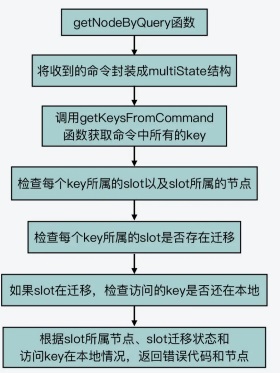
代码展示了 getNodeByQuery 函数基本执行过程
总结 #
Redis Cluster 会因为负载均衡或节点故障等原因而执行数据迁移,而
这就会导致客户端访问的 key 并不在接收到命令的集群节点上。因此,集群节点在命令执
行函数 processCommand 中,针对集群模式,就增加了额外的处理逻辑。这主要是包括
调用 getNodeByQuery 函数查询访问的 key 实际所属的节点,以及根据查询结果调用
clusterRedirectClient 函数执行请求重定向。
事实上,对于分布式集群来说,Redis Cluster 设计实现的请求重定向机制是一个不错的参
考示例。其中,MOVED 和 ASK 两种重定向情况,就充分考虑了数据正在迁移的场景,这
种设计值得我们学习。而且,getNodeByQuery 函数在查询 key 所属的 slot 和节点时,
也充分考虑了 Redis 的事务操作,在对命令访问 key 进行查询时,巧妙地使用了同一个数
据结构 multiState,来封装事务涉及的多条命令和常规的单条命令,增加了代码的复用程
度,这一点也非常值得学习。
参考 #
27 | 从MOVED、ASK看集群节点如何处理命令? 蒋德钧